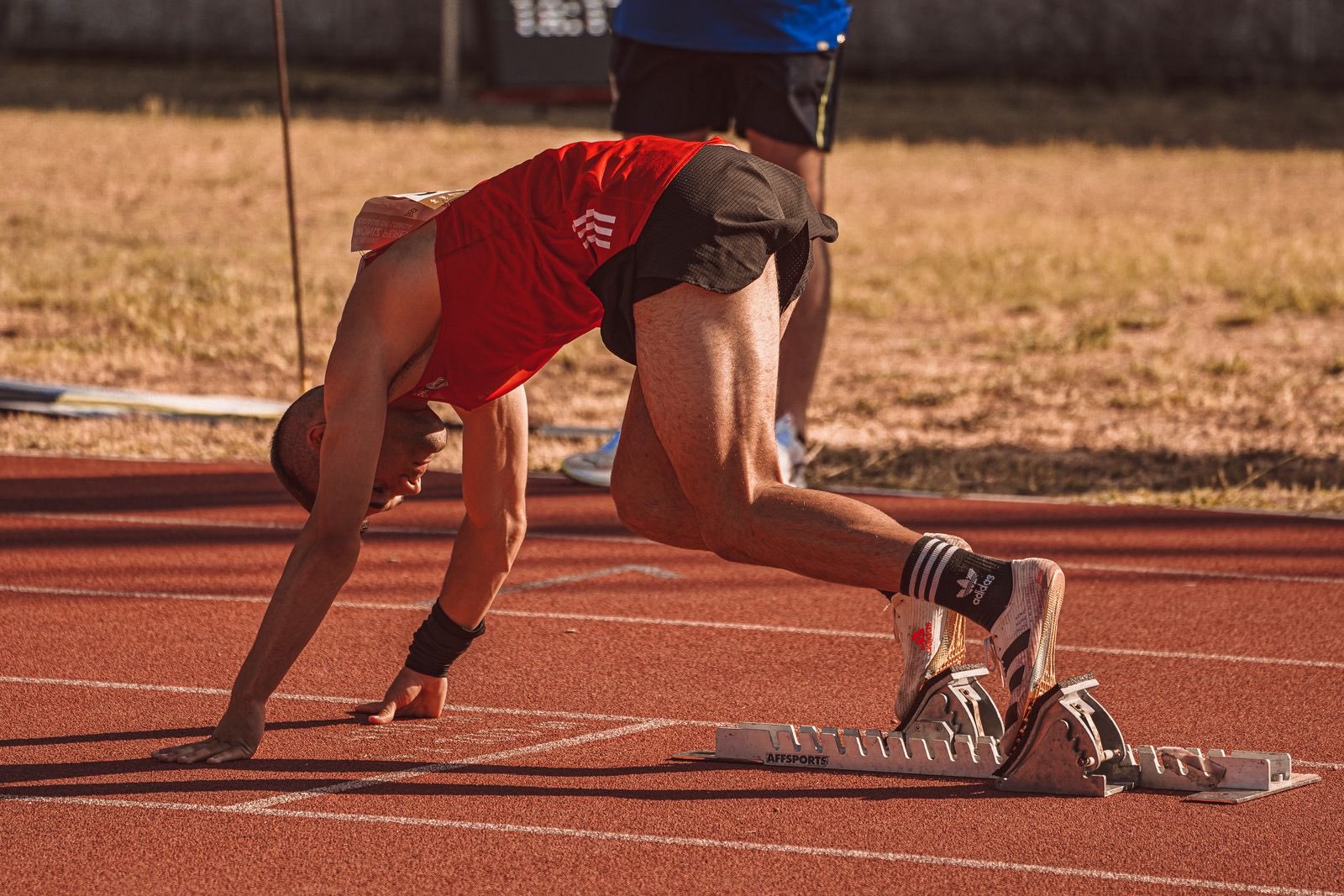
Sprint acceleration technique: drive phase, body lean and drills
The first steps out of the start are where races are won and lost. This is what good acceleration looks like, the numbers behind it, the drills that build it, and how to tell if you’re pushing or popping up.
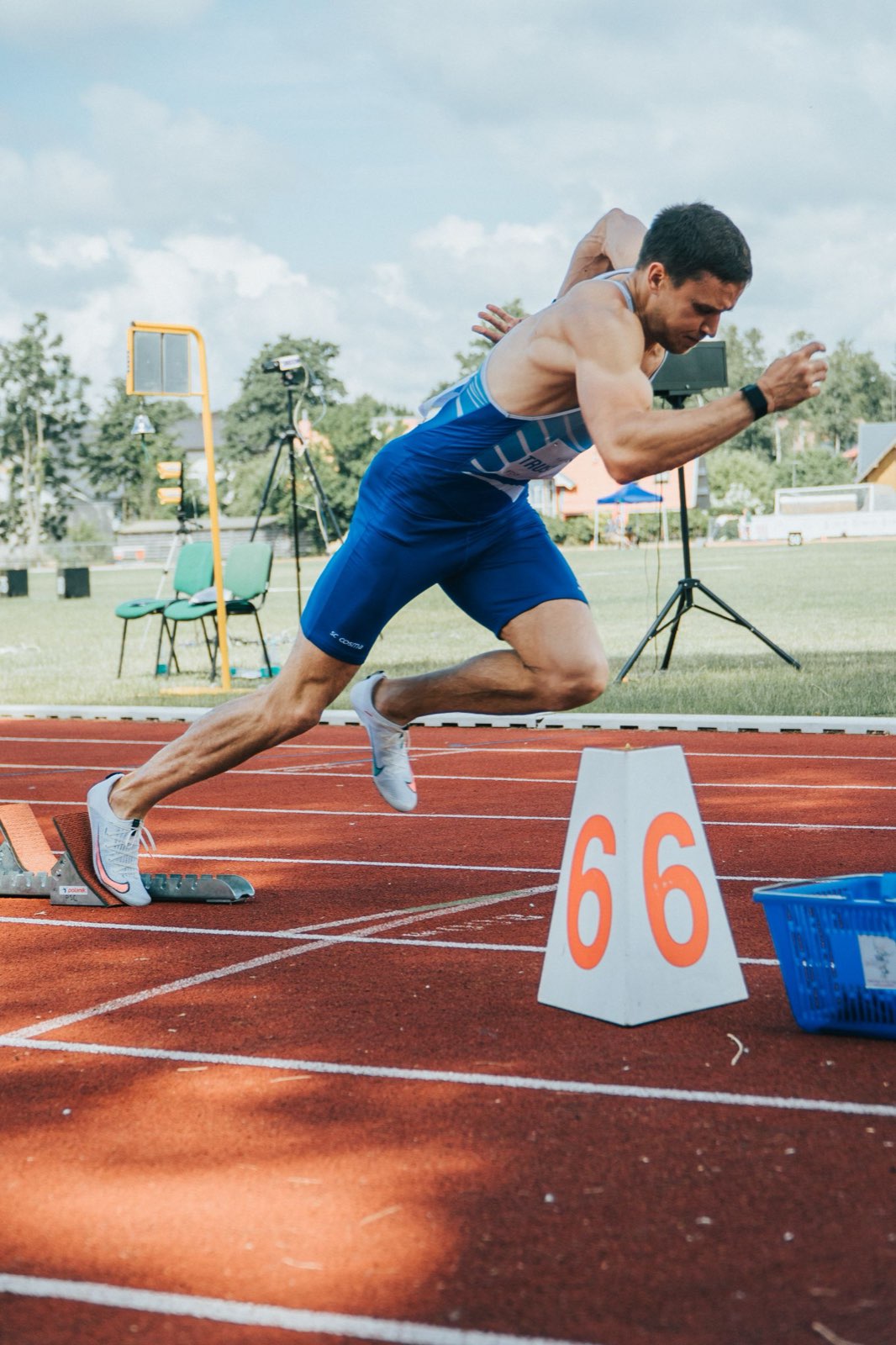
Acceleration is where technique changes fastest. On the first step out of the blocks you’re inclined well forward and on the ground for a long time. A few seconds later you’re upright, cycling your legs under your hips with contacts of less than a tenth of a second. Getting that transition right is worth more than almost anything else for most sprinters.
The aim throughout is horizontal force: pushing the ground backwards to drive your body forwards. Body angle, shin angles and arm action all come down to pointing that force in the right direction. The targets below apply to the first four steps, the steepest part of the drive phase.
Body angle
Over the first four steps your trunk should be inclined at roughly 35–50° from vertical, with a straight line running through your head, shoulders, hips and the heel of the pushing leg. Australian Athletics’ development targets put senior sprinters at 30–40° over the first 10 m and sub-elite sprinters at 35–45°. The first four steps are the steepest part of that, so they sit a few degrees further forward.
The line matters as much as the angle. The lean should come from the whole body inclining, not from flexing at the hips. If your hips sit behind your shoulders, you’ve broken at the waist: the trunk looks low, but the legs can’t push through it.
Lean has to match the force you produce
Forcing more lean doesn’t make you accelerate faster. If you lean further than your legs can support, you either stumble or break at the waist. A comparison of elite and sub-elite sprinters during acceleration, presented at the International Society of Biomechanics in Sports in 2020, found the elite group stood out for more inclined shins at touchdown, not a lower trunk; if anything, their trunk was slightly more upright. The body angle should come from how much force you put into the ground, not from pushing your chest down.
Cue: “Push the ground away”, not “fall forward”. The body angle should be the result of pushing, not a position you hold.
Positive shin angles
At touchdown, look at the shin of the landing leg. In good acceleration the knee is ahead of the ankle and the shin is angled forward: coaches call this a positive shin angle. Australian Athletics give 45–55° to the ground for senior sprinters and 55–65° for sub-elite sprinters over the first 10 m. Over steps 1–4 the shin sits slightly lower, so SprintVision’s target there is 40–55°.
The reason is the direction of force. The foot pushes along the line of the shin, so a forward-angled shin directs force backwards into the track and propels you forward. An upright shin directs it downwards, and you go up. Vertical shins in the first few steps are the most common reason athletes pop up early.
The opposite fault exists too. A shin below about 35° usually means the foot is landing well behind the hips, and the athlete is reaching back for the ground rather than striking it.
Full extension, low recovery
Each acceleration step is a push. The stance leg drives until the hip, knee and ankle are fully extended behind you (triple extension), and the swing leg comes through low, with the heel staying close to the ground. That low recovery is normal: the foot finishes its push well behind you, so there’s neither time nor need for a high heel.
As speed builds, the action becomes cyclical, with the heel folding up under the hips before the thigh drives forward. Research tracking sprinters through acceleration (Nagahara and colleagues, 2014) shows this happening gradually across the run, not at a single step. How high the heel comes up varies between good sprinters, so don’t force it. What you want to see is the transition happening: a swing knee that folds tighter as you go. SprintVision plots this for every step, so you can see where your change from pushing to cycling happens.
Step rate
Out of the start, acceleration targets are 4.0–4.5 steps per second for sub-elite sprinters and 4.5–4.9 for seniors, and world-class sprinters’ first step lasts about 0.22 seconds. SprintVision rates 4.3 or more as good.
Low turnover in the first steps usually comes from contacts that run on too long, or a rear leg that’s slow to come through. Long, powerful steps can make up for some of it, so read step rate together with step length rather than on its own. Don’t chase turnover with short, quick steps: speed out of the start comes from the force in each push.
Arm action
The arms balance the legs. Out of the start, when the legs are producing long, powerful pushes, the arms swing through a big range too: the elbow opens well past 90° on the back swing and closes as the arm comes forward. As you rise and the leg action shortens, the arms settle towards 90°. Arms held tightly bent cut the swing short; arms locked straight swing slowly.
Cue: “Punch forward, drive back.” Let the arm open up behind you as you push.
Common drive-phase faults and fixes
| Fault | What it looks like | Fix |
|---|---|---|
| Popping up | Trunk under 30° from vertical in steps 1–4; upright shins | Knee ahead of the ankle at touchdown and push back. Check the set position isn’t too low. |
| Over-leaning | Trunk over 55°; stumbling, hips behind the shoulders | Push, don’t fall. Build the first push with resisted sprints. |
| Breaking at the waist | Hips behind the shoulders; trunk low but the line is bent | A straight line from head to heel. Wall drills. |
| Pushing up, not back | Shin over about 60° to the ground at touchdown | Positive shin angles: wall drills, then sled sprints. |
| Slow first steps | Under 4.0 steps per second | Falling starts and short accelerations with full, powerful pushes. |
| Short arm swing | Elbows tight; hands barely pass the hips | Let the arms swing long and open up behind the body. |
Acceleration drills
Drills teach the positions; sprints make them fast. A few that target the drive phase directly:
- Wall drill. Lean into a wall at your drive-phase angle, arms straight and body in one line, then drive one knee up and strike the foot back down under the hips. It rehearses the body angle and positive shin angles without any speed.
- Falling starts. Stand tall and fall forward as one rigid line until you have to step, then accelerate 10–20 m. It teaches the first step to strike under the body and push, and it’s a good fix for athletes who pop up.
- Resisted sprints. A sled or a partner holding a harness lengthens the push and lowers the body angle. Keep the load light enough that the mechanics still look like sprinting.
- Hill sprints. A gentle incline does the same job as a sled: more forward lean, longer contacts and full extension on every push.
- Short accelerations. 10–30 m from blocks, a crouch or a 3-point start, at full effort.
How to see your own drive phase
Film side-on, from far enough back to see at least the first five or six steps with your whole body in shot, or hold the phone and follow the run. Film at normal speed: real-time video keeps every step timed accurately. See the filming guide for details.
SprintVision measures your trunk angle, shin angle and step rate on each step, rates the drive phase against the targets above and gives you a cue for anything outside them. Because it starts from your set position, you can see how the shape you hold in the blocks carries into your first steps.
Sources
- Australian Athletics, “Long-term development of sprinters”: sprint technique targets by phase (coachathletics.com.au).
- “A comparison of trunk and shank angles between elite and sub-elite sprinters during sprint acceleration”, ISBS Proceedings, 2020.
- Nagahara, R. et al. (2014). “Kinematics of transition during human accelerated sprinting”, Biology Open.
- “World-class male sprinters and high hurdlers have similar start and initial acceleration techniques”, Frontiers in Sports and Active Living. PMC7739645
Common questions
How far should you lean forward when accelerating in a sprint?
Over the first 10 m, senior sprinters hold their trunk about 30–40° from vertical and sub-elite sprinters about 35–45°. The first four steps sit a few degrees further forward, so a lean of roughly 35–50° from vertical over steps 1–4 is a good target. The lean should come from the whole body inclining in a straight line, not from bending at the waist.
What are the best sprint acceleration drills?
Wall drills to rehearse the body angle and shin angles, falling starts, short accelerations of 10–30 m from a crouch or blocks, resisted sprints with a sled or partner, and hill sprints.
What is the difference between acceleration and max velocity?
Acceleration is the part of a sprint where your speed is still rising: the body is inclined forward, contacts are long, each step is a push into full extension, and you rise gradually over roughly 20–30 m or more. Max velocity is the upright part where speed has peaked: contacts are short, and the leg action becomes cyclical, with the foot striking under the hips.
What is a good shin angle in the drive phase?
At touchdown over the first 10 m, senior sprinters' shins are about 45–55° to the ground and sub-elite sprinters' about 55–65°. A lower, more forward shin, with the knee ahead of the ankle, directs the push backwards, which is what drives you forward.
Why do I stand up too early out of the blocks?
The usual causes are a set position with the hips too low, upright shins at touchdown so each step pushes up instead of back, and trying to run fast with short, quick steps instead of full pushes. Keep a straight line from head to heel and push back into full extension for the first steps.
See your own numbers.
Film one rep on your iPhone. SprintVision measures every step and rates your positions against these targets, with a cue for anything outside the range.
 Free trial
iPhone