How to set up starting blocks: spacing, angles and the set position
Most block setups are copied from a teammate. Here is how to set yours up properly, step by step, and the set-position angles to check it against.
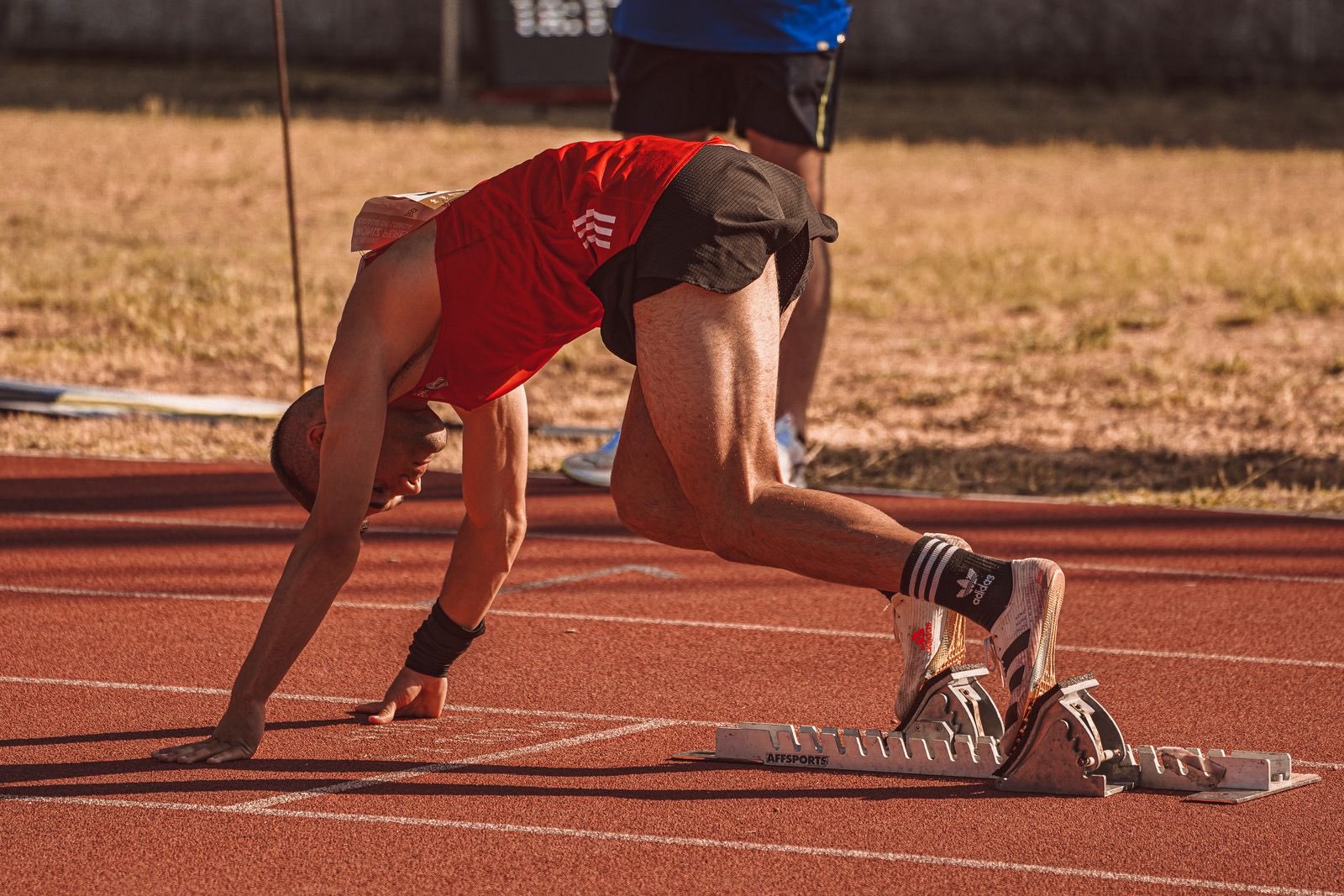
The set position is the last thing you control before the gun. The force of your first push, the angle you leave the blocks at and how quickly your rear leg comes through all start from the shape you hold here. A few degrees at the knee or hip change how long each leg can push and in which direction.
The set position has also been measured carefully in elite sprinters, so there are real numbers to check your setup against. First, the setup.
How to set up starting blocks, step by step
- Line the blocks up straight in the lane, centred, with the front just behind the start line. Push the spikes into the track and stamp the blocks down so they can’t slip.
- Set the front pedal about two foot-lengths behind the line. Measure heel to toe from the line back.
- Set the rear pedal about one more foot-length back, roughly three foot-lengths from the line. Coaches call this a medium start; moving the pedals closer together gives a bunched start, further apart an elongated one. Most sprinters use a medium start.
- Choose your front foot. Most sprinters put their stronger leg on the front pedal, because it pushes for longest. If you’re not sure, try both and keep the one that feels more natural.
- Set the pedal angles. Around 45° is a common default. Leave it there unless your set position below gives you a reason to change it.
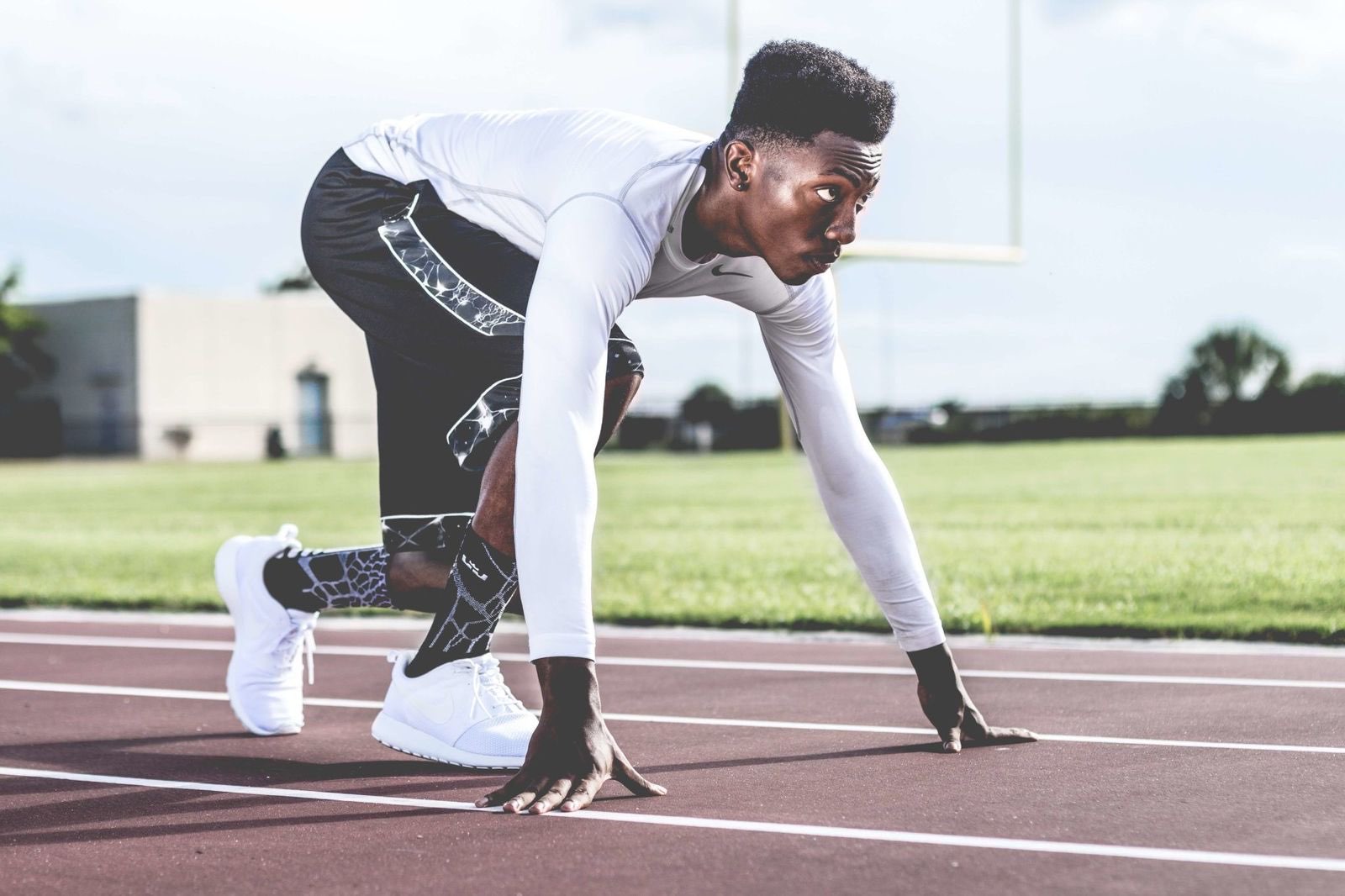
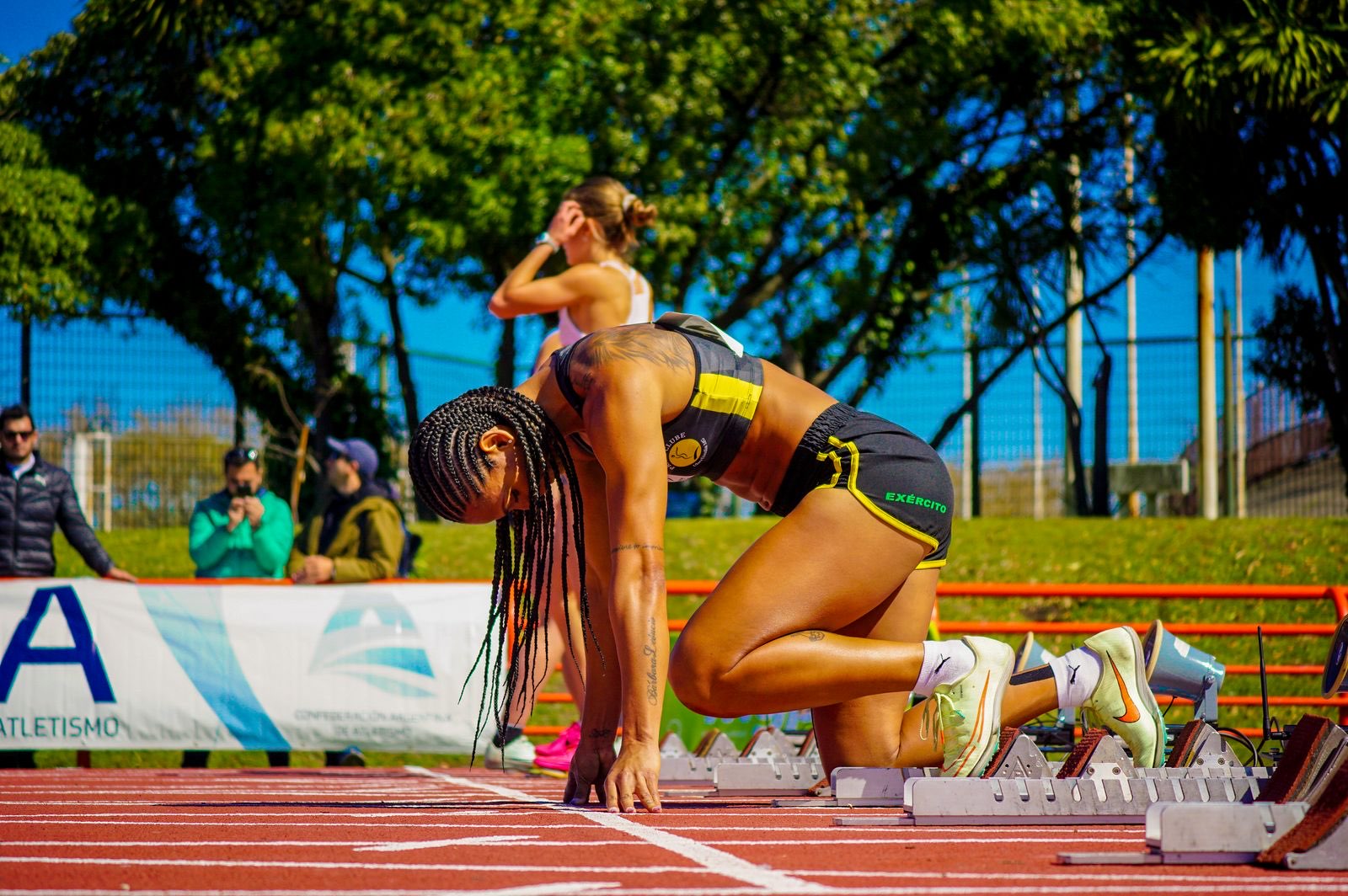
- “On your marks”: feet against the pedals, back knee on the track, hands just behind the line about shoulder-width apart, shoulders over the hands.
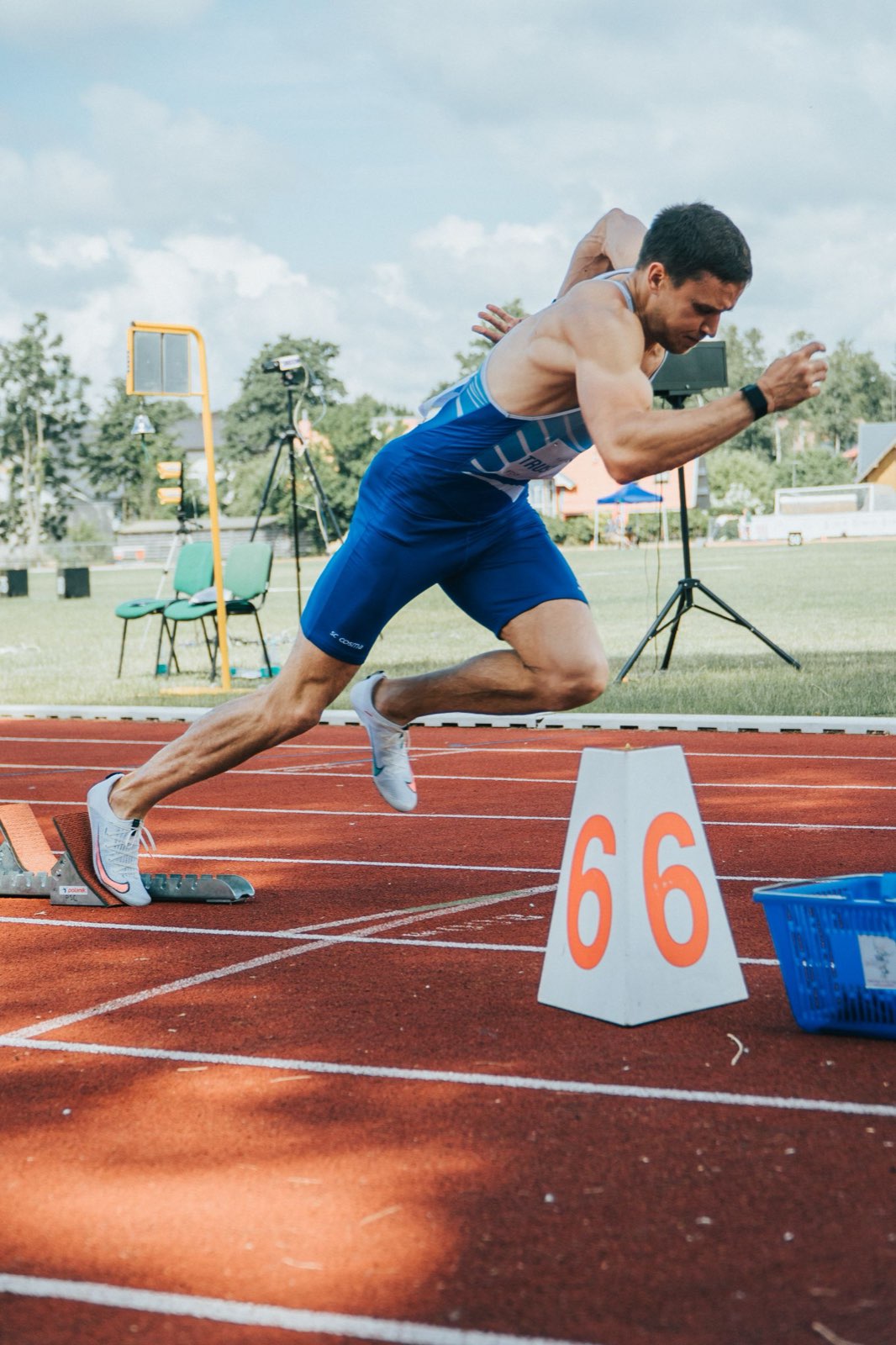
- “Set”: lift the hips until they are just above the shoulders, with your weight forward over your hands.
- Film it side-on and check your position against the guide below, then move a pedal one notch at a time.
Foot-lengths are only a starting point: leg length, hip mobility and strength all change what works. The position you end up in tells you far more than the distances.
What a good set position looks like
Viewed side-on, a strong set position has four features:
- Front knee close to a right angle, about 90–100°. The front leg produces most of the force and stays on the block longest. Near 90°, the hip and knee extensors can produce high force over a long range of motion. Much more bent and the hips are too low to push from; much straighter and there’s little range left to push through.
- Rear knee more open, about 120–135°. The rear leg leaves the block first, with a short, sharp push before it swings through into the first step. If it’s close to straight, it pushes for almost no time.
- Front hip closed. The front thigh sits tucked up towards the trunk, at roughly 40–45°, with the rear hip more open at around 80°. A closed front hip gives the front leg the longest possible push into full extension.
- Hips just above the shoulders, with the trunk pointing down about 19° from horizontal and your weight forward over the hands. That loads the legs and gives both of them room to push. Hips too high open the front hip and shorten the push; hips level with the shoulders close everything up and make the first steps more upright.
What world-class sprinters do
A study in Frontiers in Sports and Active Living measured world-class male sprinters and high hurdlers in the set position. Earlier work by Mero and colleagues on the best sprinters of their time, and a broader review of sprint start research, found very similar numbers. Hip angles are measured between the trunk and the thigh, and the trunk from horizontal, so a negative trunk angle means the shoulders are below the hips.
| Angle | World-class sprinters | Other studies | Good range |
|---|---|---|---|
| Front knee | 93 ± 5° | 96–99° | 85–105° |
| Rear knee | 121 ± 10° | 126–136° | 110–135° |
| Front hip | 45 ± 7° | 39–41° | 35–52° |
| Rear hip | 80 ± 9° | 77–80° | 70–92° |
| Trunk (from horizontal) | −19 ± 4° | – | −26° to −12° |
The good range is roughly the average plus or minus one standard deviation across these groups, and it’s the range SprintVision uses to rate a set position as Good; values a little further out are rated OK. What stands out is the consistency. Different studies, decades and athletes, yet the front knee always lands close to a right angle, the rear knee is clearly more open, and the hips sit just above the shoulders.
How to fix your set position
The angles come from where your blocks are and how high you lift your hips, so that is where the fixes are:
| What you see | Likely cause | Try this |
|---|---|---|
| Front knee too straight (over ~105°) | Hips too high, or front block too far from the line | Lower the hips slightly, or bring the front block a little closer to the line |
| Front knee very bent (under ~85°) | Hips too low, or front block too close to the line | Raise the hips a little, or move the front block slightly back |
| Rear leg nearly straight | Rear block too far back, or hips too high | Bring the rear block a little closer, or lower the hips slightly |
| Rear knee tightly bent | Rear block too close to the front block | Move the rear block back a notch |
| Front hip very open | Hips too high | Lower the hips so the front leg can push for longer |
| Hips level with or below the shoulders | Not lifting enough into “set” | Lift the hips slightly on the “set” command |
Change one thing at a time and film again. A notch on the blocks can move the front knee by several degrees, and it is easy to overcorrect.
Don’t copy an angle, find your position
These numbers describe where elite sprinters end up, not a pose to force yourself into. Leg length, hip mobility and strength all change what feels powerful. Use the ranges as a check: if your front knee is 115° and your hips are well above your shoulders, there is probably an easy improvement waiting. If you are inside every range, spend your time on the first steps instead.
How to measure your own set position
You need a side-on view, with the camera at roughly hip height and level, so the angles aren’t distorted. Film the whole start, not just the set position: the first steps tell you whether the position actually worked. Our filming guide covers where to stand.
SprintVision finds the set position in your video automatically, measures the knee, hip and trunk angles and rates each one against the ranges above, with a cue for anything outside them. Then it carries on through the drive phase, so you can see if a better set position turned into better first steps.
Sources
- “World-class male sprinters and high hurdlers have similar start and initial acceleration techniques”, Frontiers in Sports and Active Living. PMC7739645
- Mero, A. and colleagues (1983), set-position angles of the best sprinters: front hip 41°, front knee 99°, rear hip 80°, rear knee 136°.
- Reviews of sprint start biomechanics reporting set-position angles of 39 ± 7° (front hip), 96 ± 12° (front knee), 77 ± 9° (rear hip) and 126 ± 16° (rear knee).
Common questions
How far apart should starting blocks be?
A common starting point is the front pedal about two foot-lengths behind the start line and the rear pedal about three foot-lengths behind it, measured heel to toe. That gives a medium start, which most sprinters use. Then adjust so that in the set position your front knee is near 90° and your rear knee around 120–135°.
What angle should starting block pedals be?
Around 45° is a common default for the pedals. Change the angle only if your set position or first push calls for it, one notch at a time, and film each change.
Which foot goes in front in the starting blocks?
Most sprinters put their stronger, more powerful leg on the front pedal, because it pushes for longest. If you are not sure, try a few starts with each foot in front and keep the one that feels more natural and gets you out faster.
What is the best front knee angle in the set position?
Studies of world-class sprinters measure the front knee at about 93° (± 5°) in set, and other studies of top sprinters find 96–99°. A front knee between roughly 85° and 105° is a strong position to push from.
Should my hips be higher than my shoulders in the set position?
Yes, slightly. In world-class sprinters the trunk points down about 19° from horizontal in set, so the hips sit just above the shoulders. Hips far higher than the shoulders open the front hip and shorten the first push.
See your own numbers.
Film one rep on your iPhone. SprintVision measures every step and rates your positions against these targets, with a cue for anything outside the range.
 Free trial
iPhone