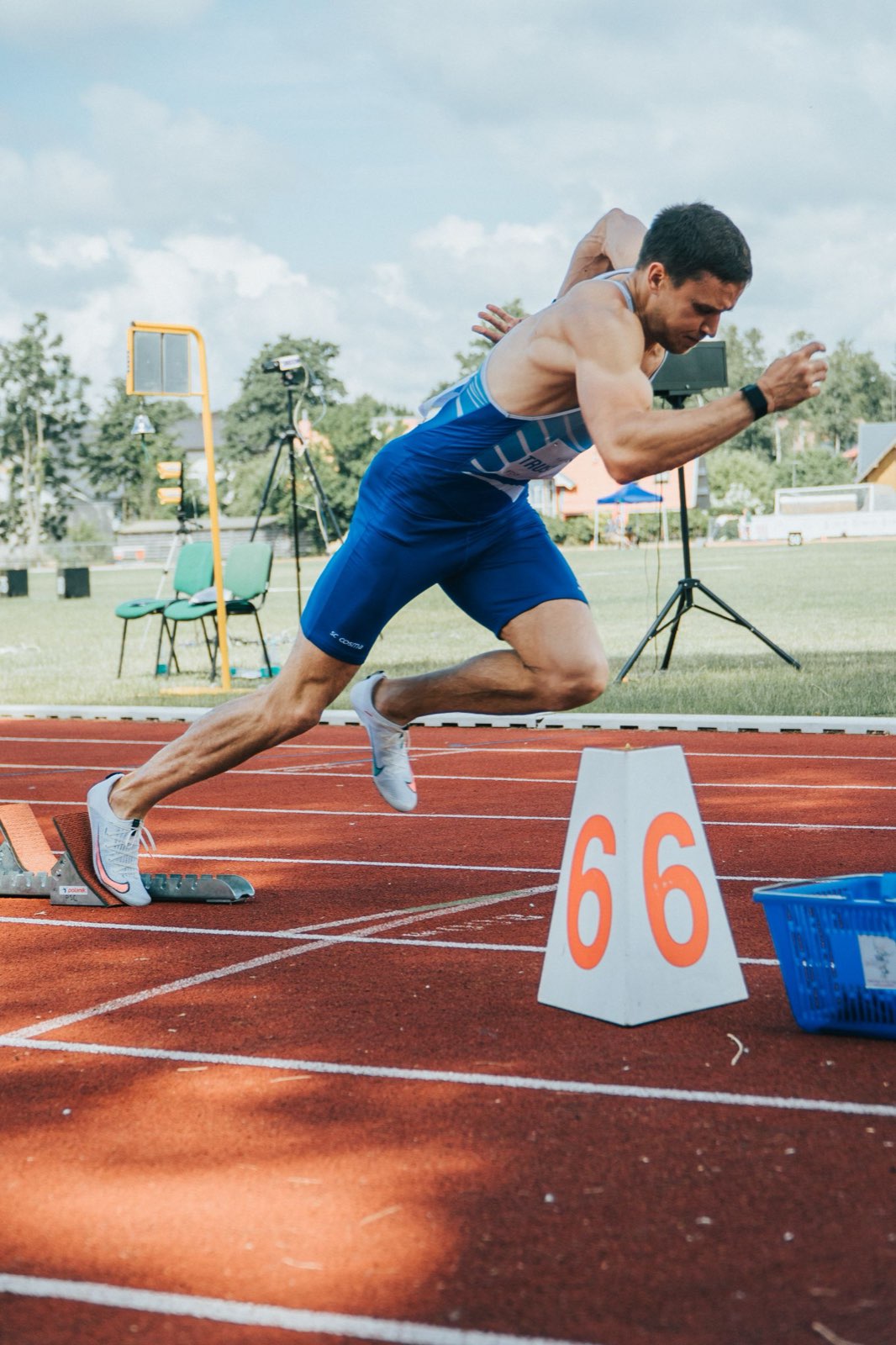
How to increase stride length and stride frequency for sprinting
Every gain in sprint speed comes from longer strides, quicker strides or both. The two are linked, so improving one the wrong way costs you the other. Here is what limits each, and how to improve them.

Your speed is the product of two things: how far you travel with each stride (stride length) and how many strides you take per second (stride frequency).
Speed = stride length × stride frequency
Run 2.15 m per stride at 4.6 strides per second and you’re moving at 9.9 m/s. Any improvement in speed shows up as longer strides, quicker strides or both. In sprinting, a stride usually means a single step, from one foot touching down to the other, and that’s how it’s used here.
The two aren’t independent. A study of 36 sprinters by Hunter, Marshall and McNair (2004) found a negative interaction between them: athletes with longer strides tended to have a lower stride frequency, and the other way round. The biggest factor was how much each athlete projected themselves upwards at take-off. Push more vertically and you spend longer in the air, so the stride gets longer but the frequency drops. Reach for the ground and the stride gets longer while you brake. The aim is to raise one without giving the other away.
Which one is holding you back?
There is no ideal mix that suits everyone. Salo and colleagues (2011) followed elite sprinters across many races and found that some ran their best times with a higher stride frequency and others with longer strides. Leg length is part of it: longer-legged sprinters tend to take longer strides at a lower frequency.
Film yourself side-on at speed and look for these signs:
| Likely limit | What it looks like |
|---|---|
| Stride length | Short strides for your speed and leg length; a short flight; in acceleration, pushes that don’t finish in full extension |
| Stride frequency | Long ground contacts compared with the flight; the heel recovering low and long behind you; a top-speed frequency well below the 4.4–4.8 per second of trained sprinters |
| Overstriding | The foot lands ahead of the knee, with the shin angled back at touchdown; strides look long but the frequency is low |
Your own runs are the best guide. Compare a good rep with a poor one: when you run well, which one changes?
How to increase stride length without overstriding
Stride length is decided mostly during ground contact, not in the air. The more force you put into the ground in the right direction, the further you travel before the next foot lands. Weyand and colleagues (2000) compared faster and slower runners at their top speeds and found the faster runners didn’t reposition their legs through the air any more quickly. They applied greater force to the ground in a shorter contact.
Strike under your centre of mass
Overstriding is reaching for a longer stride: the foot lands well ahead of your centre of mass, with the shin angled back and the knee close to straight. The stride gets longer, but every contact starts with a braking force, so you lose speed. Strike the ground close under the hips, with the foot already moving down and back as it lands, so the force keeps driving you forwards.
Stiff ankle, stiff knee
At touchdown, hold the ankle dorsiflexed, toes pulled up towards the shin, so you land on the ball of the foot instead of letting the heel sink. The knee should be only slightly bent, around 150° in fast sprinters, and shouldn’t collapse through contact. A stiff leg makes use of the stretch-shortening cycle: the muscles and tendons absorb the landing and return it as force. If the ankle or knee gives, that force is lost and the stride shortens.
Push into full extension when accelerating
In acceleration, stride length grows with every step, from roughly a metre out of the blocks to over two metres for trained sprinters at top speed. It grows because each push finishes in triple extension, with a positive shin angle directing the force backwards. Cut the pushes short with quick, choppy steps and the stride never gets the chance to grow. More in sprint acceleration technique.
Build strength and power
Because stride length comes from force, a large part of improving it long term is getting stronger and more powerful: lower-body strength work, plus plyometrics such as bounds that train you to produce force in a short contact. Technique makes sure that force reaches the ground in the right direction.
Drills for stride length
| Drill | What it trains | Key cue |
|---|---|---|
| Alternate-leg bounds | Force on each contact and full extension | “Push the ground back” |
| Straight-leg bounds | A stiff leg striking under the hips | “Paw the ground back” |
| Resisted or hill sprints | Longer, more forceful pushes in acceleration | “Finish every push” |
| Wicket runs | Longer strides with the foot still landing under the hips | “Run tall, strike down” |
For wicket runs, place mini-hurdles or flat markers in a line, spaced to your stride length at speed. Widening the spacing a little at a time asks for a longer stride while the wickets stop you reaching for it.
How to increase stride frequency
Every stride is a ground contact plus a flight. Shortening the flight would cost you length, so the frequency you want comes from shorter contacts that still produce the same force. At top speed, contacts in elite sprinters already last under a tenth of a second.
Shorter contacts, same force
Short contacts come from applying force quickly, not from getting off the ground early. A sprinter who simply tries to move the feet faster usually pushes less, which shortens the flight and the stride with it. What you want is the same force in less time: a dorsiflexed ankle and a stiff leg at touchdown, and plyometrics that train the stretch-shortening cycle. More in ground contact time.
Fix overstriding first
A foot that lands out in front stays on the ground until your body has passed over it, which lengthens the contact and lowers your frequency. Low frequency is often a foot-strike problem rather than a slow leg, so check your shin angle at touchdown before anything else.
Heel recovery and front-side mechanics
After toe-off, the heel should fold up under the hips and the thigh should come through high, to about 70° from vertical. If the heel trails low and long behind you, the leg comes through late and tends to reach for the ground. Most of the leg action should happen in front of your body rather than behind it, which coaches call front-side mechanics.
Arms in rhythm
The arms move in time with the legs. Keep the elbows near 90°, drive them back from the shoulder and keep the shoulders relaxed. A tight, short or wide arm action, or tension in the neck and shoulders, makes a high rhythm harder to hold.
Drills for stride frequency
| Drill | What it trains | Key cue |
|---|---|---|
| Dribbles | Fast heel recovery and quick contacts under the hips | “Heel to hip, foot down under you” |
| Pogo jumps | Ankle stiffness and short contacts | “Toes up, minimal ground time” |
| Fast-leg drill | The swing leg recovering under the hips and striking down | “Heel up, step over, strike down” |
| Flying sprints | Frequency at real top speed | “Relaxed and quick” |
Holding frequency late in a race
When sprinters slow down in the last part of a 100 m, it’s usually frequency that drops. In a study of well-trained sprinters, Bezodis and colleagues found that, on average, stride frequency fell from 4.40 to 4.25 per second between 30–40 m and 70–80 m, while stride length didn’t change. The fastest in the group limited their slowdown by lengthening their stride as their frequency fell. It’s one reason coaches put so much emphasis on staying relaxed and holding your mechanics late in a race.
How to measure stride length and frequency
- Stride frequency = strides ÷ time. 10 strides in 2.2 s is 4.5 per second.
- Stride length = distance ÷ strides. 20 m in 10 strides is 2.0 m.
- From video: count the frames from one foot touching down to the other foot touching down, then divide the frame rate by that number. 7 frames at 30 fps is 30 ÷ 7 = 4.3 per second. One frame either way changes the answer a lot (6 frames is 5.0, 8 frames is 3.75), so average over several strides.
- Cadence is the same measure in strides per minute, common in distance running: 4.6 per second is 276 per minute.
SprintVision measures both from a normal phone video. It marks each footprint on the track, measures the length and timing of every stride and plots the whole run, so you can see how your stride length and frequency build from the start to top speed, and where they level off. Frequency is rated against research targets; length is shown so you can compare your runs.
Sources
- Hunter, J. P., Marshall, R. N. and McNair, P. J. (2004). “Interaction of step length and step rate during sprint running”, Medicine & Science in Sports & Exercise. PubMed
- Salo, A. I. T. et al. (2011). “Elite sprinting: are athletes individually step-frequency or step-length reliant?”, Medicine & Science in Sports & Exercise.
- Weyand, P. G. et al. (2000). “Faster top running speeds are achieved with greater ground forces not more rapid leg movements”, Journal of Applied Physiology.
- Bezodis, I. N. et al. “Changes in step characteristics between the maximum velocity and deceleration phases of the 100 metre sprint run”, ISBS Proceedings Archive. Link
- “Kinematics of maximal speed sprinting with different running speed, leg length, and step characteristics”, Frontiers in Sports and Active Living, 1:37, 2019.
Common questions
How do you increase stride length without overstriding?
Put more force into the ground instead of reaching for it. Strike close under your centre of mass with the foot moving down and back, keep the ankle dorsiflexed and the leg stiff at touchdown, push into full triple extension when accelerating, and build strength and power. Bounds, resisted or hill sprints and wicket runs all help.
How do I increase my stride frequency for sprinting?
First check you aren't overstriding: a foot landing in front of the hips lengthens the contact and lowers your frequency. Then work on shorter contacts that keep the same force (a stiff, dorsiflexed ankle and plyometrics such as pogo jumps), fast heel recovery and front-side mechanics (dribbles and fast-leg drills), and sprinting at full speed.
Is it better to have a longer stride or a faster stride?
Neither on its own. Speed is stride length times stride frequency, and the two tend to trade off against each other. Elite sprinters differ: some run their best races with a higher frequency, others with longer strides. Improve whichever is limiting you without giving up the other.
What is stride frequency?
Stride frequency is the number of strides you take per second, also called step frequency, stride rate or turnover. Sprinters at top speed take about 4.6 per second. Strictly, a stride is two steps, but in sprinting stride frequency usually means steps per second.
How do you calculate stride frequency?
Divide the number of strides by the time they took: 10 strides in 2.2 s is 4.5 per second. From video, count the frames from one foot touching down to the other foot touching down and divide the frame rate by that number: 7 frames at 30 frames per second is 30 ÷ 7 = 4.3 per second.
What was Usain Bolt's stride length?
Bolt took about 41 strides in his 9.58 s 100 m world record, an average of more than 2.4 m each, at around 4.3 strides per second. Most elite men take about 44–48. His frequency was similar to his rivals'; what set him apart was the length of each stride, helped by his height.
See your own numbers.
Film one rep on your iPhone. SprintVision measures every step and rates your positions against these targets, with a cue for anything outside the range.
 Free trial
iPhone