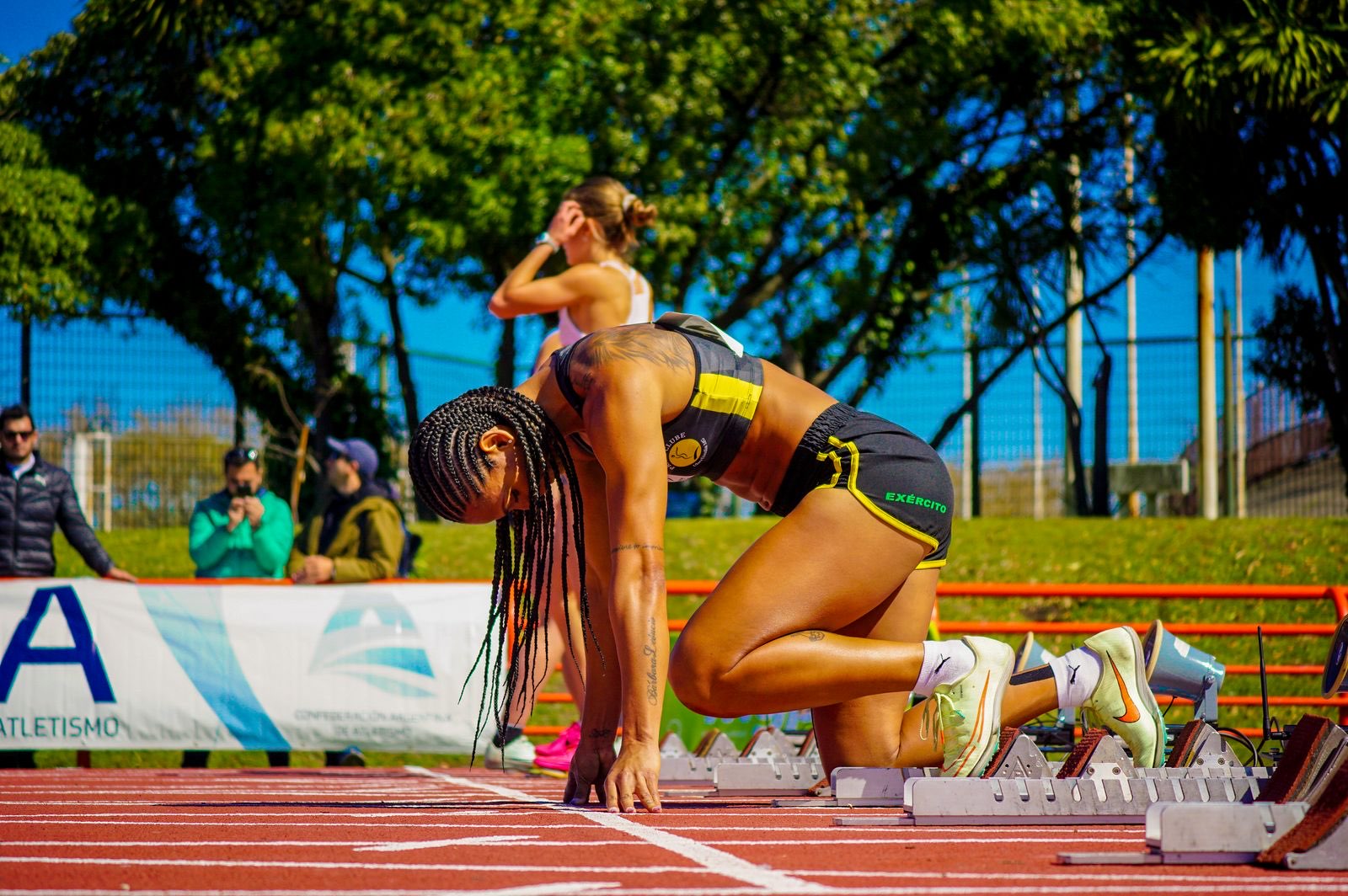
Ground contact time in sprinting: what’s good and how to reduce it
At top speed, elite sprinters touch the ground for less than a tenth of a second per step. Here is what a good contact time is, how to bring yours down the right way, and how precise each way of measuring it really is.

Every step of a sprint has two parts. The ground contact, when your foot is on the ground and pushing, and the flight, when you are in the air between one foot leaving and the other landing. Together they make up the step time, and one divided by the step time is your step frequency.
Contact is where all your speed comes from. It is the only time you can push. So how long it lasts, and how much force you produce in that time, is close to the heart of sprinting.
What is a good ground contact time?
| Phase | Ground contact | Flight |
|---|---|---|
| First steps out of the blocks | Long, roughly 0.15–0.20 s | Short |
| Top speed, elite sprinters | About 0.08–0.10 s | About 0.12 s |
| Distance running (what running watches report) | Roughly 0.20–0.30 s | – |
If your running watch shows a ground contact time of 250 ms, that’s a distance-running number at a much slower speed. It isn’t comparable with sprinting.
Through acceleration, contacts get shorter and flights get longer with almost every step. By top speed, a fast sprinter spends less time on the ground than in the air.
Why shorter contacts go with faster running
When Weyand and colleagues (2000) compared fast and slow runners at top speed, they found the fast ones weren’t moving their legs through the air much quicker. They were hitting the ground harder in a shorter time. More force means a longer flight; a shorter contact means less time spent on the ground in each step.
That has a practical consequence: short contacts are a result of a strong, stiff leg that produces force quickly, not a goal to chase directly. You can shorten your contacts by pushing less, and you will get slower. What you want is the same or more force in less time.
How to reduce ground contact time
If your contacts at speed are long compared with your flights, look at:
- Where the foot lands. A foot landing ahead of your centre of mass creates a braking force, and the contact lasts until your body has passed over it. Check your shin angle at touchdown.
- Ankle and knee stiffness. Land with the ankle dorsiflexed, toes pulled up towards the shin, and the knee only slightly bent, so the leg stays stiff through contact. An ankle or knee that gives on landing absorbs force instead of returning it. Cue “stiff, active leg”.
- Strength and reactivity. Pogo jumps, bounds, hurdle hops and other plyometrics train the stretch-shortening cycle: the leg’s ability to absorb load and return it quickly. Keep contacts short and the effort high, with low volume.
- Max-speed exposure. Short flying sprints at full speed, so the leg learns to work in that short window.
In the first steps, long contacts are normal and good. You are pushing to accelerate and need the time to do it.
How to measure contact time, and how accurate each method is
| Method | Time resolution | Good for |
|---|---|---|
| Force plates | Around 1 ms | Research, a few steps at a time |
| Optical timing systems along the track | Around 1 ms | Many steps in a row; expensive |
| High-speed video, 240 fps | About 4 ms per frame | Precise timing over a short section |
| Phone video, 60 fps | About 17 ms per frame | Reasonable estimates |
| Phone video, 30 fps | About 33 ms per frame | Estimates; comparing runs |
The problem with video is simple maths. At 30 frames per second, each frame covers 33 ms. A ground contact lasts only 3–5 frames, and the real touchdown and take-off happen somewhere between frames. So each contact time can be off by 30–60 ms, which is a large error when the contact itself lasts under 100 ms.
That doesn’t make phone video useless for contact time. Errors average out over many steps, and if you film your runs the same way each time, a real change still shows up. It does mean you shouldn’t read too much into one step, or compare your numbers with values measured on a force plate.
How SprintVision handles it
SprintVision analyses normal, real-time video, so you can film any session without special settings. It times the contact and flight of every step, and shows them as estimates for exactly the reason above. They aren’t rated against targets. Use them to compare runs filmed the same way, and to watch your contacts shorten as you accelerate.
The positions that decide contact time, like where the foot lands, the shin angle and the knee at touchdown, are measured from single frames, so they don’t have this problem. Those are rated, with a cue if they’re outside the target.
Sources
- Weyand, P. G. et al. (2000). “Faster top running speeds are achieved with greater ground forces not more rapid leg movements”, Journal of Applied Physiology.
- Nagahara, R. et al. (2014). “Kinematics of transition during human accelerated sprinting”, Biology Open.
- “Kinematics of maximal speed sprinting with different running speed, leg length, and step characteristics”, Frontiers in Sports and Active Living, 1:37, 2019.
Common questions
What is a good ground contact time for sprinting?
At top speed, elite sprinters' contacts last about 0.08–0.10 seconds (80–100 ms). Contacts are much longer in the first steps out of the blocks, when the athlete is pushing to accelerate, and much longer again in distance running.
What is a good ground contact time for running?
Running watches measure ground contact time at distance-running speeds, where values of roughly 200–300 ms are typical and faster runners sit at the lower end. Those numbers aren't comparable with sprinting, where contacts at top speed are under 100 ms.
How do you reduce ground contact time?
Land with the foot under your hips rather than in front, keep the knee slightly bent and stiff at touchdown instead of letting it collapse, and train the leg to produce force quickly with plyometrics such as pogo jumps, bounds and hurdle hops. Shorter contacts should come from more force in less time, not from pushing less.
Is shorter ground contact time always better?
Not on its own. Shorter contacts go with faster running because faster sprinters produce more force in less time. If you shorten contacts by pushing less, you won't get faster. In acceleration, longer contacts are normal and useful because you need time to push.
How do you measure ground contact time?
The most accurate tools are force plates and optical timing systems laid along the track. High-speed video at 240 frames per second or more is also precise. Normal phone video at 30 frames per second gives an estimate that can be off by 30–60 ms per step, which is fine for comparing runs filmed the same way.
See your own numbers.
Film one rep on your iPhone. SprintVision measures every step and rates your positions against these targets, with a cue for anything outside the range.
 Free trial
iPhone